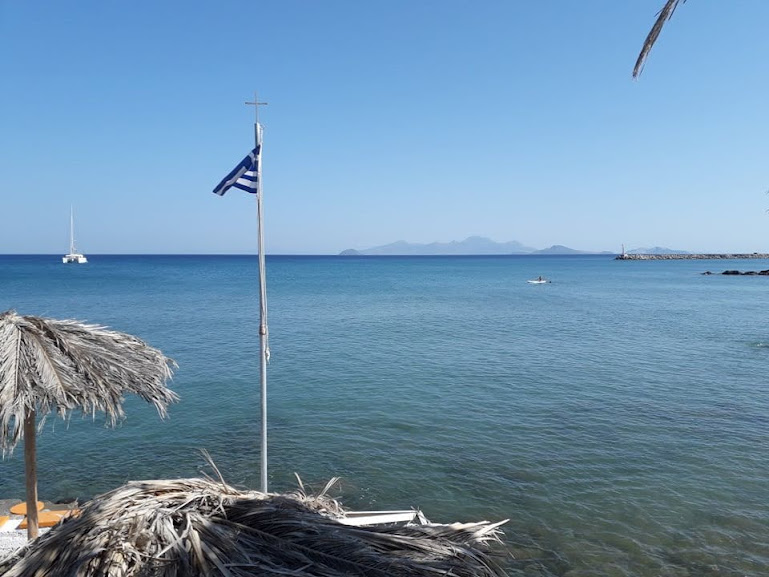
Kardamena (Greek: Καρδάμενα), is a small Greek village 7 km from Kos Island International Airport at Antimachia, situated mid-way along the south coast of the island of Kos. Once a small fishing village, it has emerged as one of the most popular summer destinations, especially for British tourists, over the past two decades, offering scores of pubs and restaurants, bars and night clubs and water sports facilities. It reported a population of 1,783 inhabitants at the 2001 census and has a land area of 35.150 km².
Kardamaina is built on the site of the ancient settlement of Alasarna. During the 2nd century BC, Alasarna was an important urban center with one thousand citizens, to whom the slaves and the metics should be added.
The archaeological excavations have brought to light some impressive ruins. A Temple of Apollo, an extensive Early Christian settlement (from the very few known in Greece), as well as four basilicas that belong to the same period. Also many stone objects of everyday use (millstones, tools, vases, vessels, etc.), mostly made of volcanic and sedimentary rocks have been recovered so far.
Sunday, 9 January 2022
Positivity rates, updated 6 January 2022
Friday, 31 December 2021
SunBeam Apart Hotel: Positivity rates, updated 30 December 2021
https://www.ecdc.europa.eu/en/covid-19/situation-updates/weekly-maps-coordinated-restriction-free-movement
Saturday, 25 December 2021
Sunday, 6 June 2021
Sunday, 31 January 2021
SunBeam Apart Hotel:Positivity rates, updated 28 January 2021
Less than 4% the positivity rate for Greece this week!!!
https://www.ecdc.europa.eu/en/covid-19/situation-updates/weekly-maps-coordinated-restriction-free-movement
Thursday, 21 January 2021
SunBeam Apart Hotel: Positivity rates, updated 21 January 2021
Thursday, 14 January 2021
SunBeam Apart Hotel: Only green areas on ECDC coronavirus map are in Greece
Epirus in northwestern Greece, the Ionian Islands and the Aegean islands are currently the only green areas in Europe, according to a revised map published on Thursday by the European Center for Disease Prevention and Control (ECDC) charting the spread of the coronavirus. In contrast, red is the prevalent color across most of Europe, which indicates 150 confirmed cases of the coronavirus per 100,000 population. At the same time, most of Greece, Finland and Iceland are orange.
The ECDC does not collect data on the United Kingdom, Switzerland, the Balkan countries (excluding those belonging to the EU), Ukraine, Belarus and Russia.
https://www.ekathimerini.com/261230/article/ekathimerini/news/only-green-areas-on-ecdc-coronavirus-map-are-in-greece
Saturday, 18 July 2020
SunBeam Apart Hotel: Good news of the day. After 2803 tests, a case of Koronio was NOT found in British tourists
The news are very good for British tourists who came to Greece on July 15 and 16.
According to information, on July 15, 1,366 tests were performed on passengers who flew directly from British airports in our country. On July 16, 1,437 tests were performed. The results of all tests, both days, were negative.
Kos is beautiful and safe. Enjoy the Summer Restart...
Wednesday, 15 July 2020
SunBeam Apart Hotel: Kos welcomes British friends.
From today Greece is open for flights from Britain. The first flights are expected in Kos airport tomorrow.
We hope that with attention, cooperation and faithful observance of the instructions, everything will go well and the British friends will enjoy summer holidays in the wonderful and safe Kos and Kardamena.
Welcome to Kos-Kardamena British friends. Have a nice trip and wonderful holidays.
Book your holidays now. August in Greece is wonderful.
And don't forget, before you fly to Kos, please fill this form:
Passenger Locator Form at: https://travel.gov.gr/#/
Saturday, 27 June 2020
Passenger Locator Form (PLF). From July 1, Greece opens for Holidays
From Thursday, July 9, to Monday, August 31, 2020, the mandatory completion of the Passenger Locator Form (PLF) by all passengers of international flights to Greece must be done 24 hours before the check in and not 48 hours until 8/7/2020. At the web address https://travel.gov.gr/#/ there are detailed instructions on how to complete the above electronic form, as well as for the QR CODE of each passenger.
Beginning July 1, 2020, the Greek government has determined how the country will welcome travellers, carry out the necessary diagnostic screening and keep everyone safe throughout the season.
The Passenger Locator Form (PLF) is a key element in the planning. All travellers are obliged to complete their PLF at least 48 hours before entering the country, providing detailed information on their point of departure, the duration of previous stays in other countries, and the address of your stay while in Greece.
Start Here:
travel.gov.gr/#/
Saturday, 30 May 2020
SunBeam Apart Hotel: You can now change your reservation...
| Kardamena harbour from SunBeam, May 2020 |
All tourism businesses face major financial problems.
| May 2020 |
Sunday, 17 May 2020
SunBeam Apart Hotel: Greece is leading the effort to restart tourism in Europe.
Greece is leading the effort to restart tourism in Europe. There is a coordinated effort by our government and all private sector to open the majority of our destinations and facilities by July 1st. Bilateral agreements and flight connectivity will be key. https://t.co/7yyVf1x29n— Andreas Andreadis (@AAAndreadis) May 16, 2020
Monday, 11 May 2020
Greece Records Zero Coranavirus Deaths for Second Consecutive Day
Greece’s health authorities announced that there were only ten new coronavirus cases on Monday and no deaths. This is the second consecutive day that no new fatalities have been recorded in the country.
The total of infections since the start of the outbreak in the country amounts to 2,726.
So far, of the total infections, 607 (or 22.3 percent) are traced to traveling abroad and 1,374 (50.4 percent) to known cases exclusively within Greece.
Thirty-two hospitalized Greeks are currently intubated. The average age of these victims is 67 years old and twelve of them are women. Nearly all (96.9 percent) have an underlying illness or are over 70 years of age. Another 87 have been discharged from ICUs.
The number of fatalities since the beginning of the outbreak total 151 (and only 37 were women). The average age of the deceased was 74 years and 93.4 percent of these individuals had some underlying illness and/or were 70 years of age or more.
In total, 99,363 tests for the virus have taken place in Greece.
Monday, 4 May 2020
SunBeam Apart Hotel: Coronavirus, Greece and Croatia acted fast, now need to save summer
But the coronavirus pandemic threatens to ruin the summer season, so vital to the economies of both countries, even though they moved fast to stop the spread. Their proximity to Italy concentrated minds, as Covid-19 started spreading rapidly.
How did they react?
Croatia was on alert soon after news of the Covid-19 epidemic emerged from China.
The Institute of Public Health had published guidelines even before the arrival of a busload of tourists from Wuhan in late January.
Local media raised concerns that Chinese workers constructing the Peljesac Bridge on the Dalmatian coast might have returned from virus-affected areas in China.
In Greece, too, the government moved well before the virus reached its shores, as it saw infections spread in Italy. An ad-hoc scientific committee was set up with top epidemiologists, virologists and infectious disease experts.
Some accused the government in Athens of not just entrusting the handling of the pandemic to scientists, but of handing over responsibility too.
When did lockdown start?
The first confirmed Croatian case came on 25 February, almost a month after Italy and the UK. It involved a man who had been in Milan six days earlier to see the now-notorious Champions League match between Atalanta and Valencia.
The match has been linked to one of Italy's biggest outbreaks - in Bergamo, where Atalanta are based.
The first confirmed case in Greece was recorded a day later than Croatia, on 26 February. And both countries reacted swiftly.
Greek Prime Minister Kyriakos Mitsotakis imposed tighter restrictions over a period of weeks and it was made clear that no exceptions could be made:
- 27 February: carnival festivities are cancelled
- 10 March: schools and universities are closed
- 12 March: Olympic flame is lit in Ancient Olympia with a handful of VIP guests; Greece confirms first Covid-19 death
- 13 March: cafes and restaurants are shut
- 22 March: restrictions on movement imposed
Sunday, 26 April 2020
SunBeam Apart Hotel: How sun exposure alters the microbiome and makes you healthier
How sun exposure alters the microbiome: https://t.co/ozNF2FRV7B— Discover Magazine (@DiscoverMag) April 25, 2020
Friday, 24 April 2020
SunBeam Apart Hotel: How Greece is beating coronavirus despite a decade of debt
How Greece is beating coronavirus despite a decade of debt https://t.co/haRWrlD9kf— ΦίλιπποςΠαπανικολάου (@filpap) April 14, 2020
Tuesday, 21 April 2020
SunBeam Apart Hotel: How coronavirus changed the world in three months
In just three months, the coronavirus has turned the world upside down. But how did it play out so quickly? We take a look back to where it all began – from its origins in south east Asia, to its acceleration across Europe and the US. As the infection rate increased and countries went into lockdown, people began to find imaginative and inspiring ways of coping with our new reality
Monday, 20 April 2020
SunBeam Apart Hotel: Hippocrates of Kos – biography
He was born into a family of physicians, the Asklepiades, who were the hereditary physician-priests of the Asklepieion and considered descendants of the god of medicine, Asclepius. The island of Kos itself had a strong medical tradition, with its already famous Asklepieion and its medical school. His father was Heraclides and his mother, Fenareti, who was considered a descendant of the mythical hero Heracles. Hippocrates had two sons, Thessalos and Drakon, who, following family tradition, also became famous physicians, like his son-in-law Polyvos.
Hippocrates was taught medicine by his grandfather and father, in a propitious environment, as he studied within the Asklepieion itslef, which provided him with numerous clinical data for research and practice. Hippocrates also studied philosophy and rhetoric, as was the custom those days.
When Hippocrates became an adult and during a decade he visited various places for research purposes, increasing his knowledge and experience. We don’t know with certainty which places he visited but most historians name Skythia, Delos, Egypt, Libya, Thasos, Thrace, Propontis, Ellispon, Thessaly, Athens and Smyrna.
MEDECINE BEFORE HIPPOCRATES
In Ancient Greece, although the practice of medicine remained religious, empirical medicine developed itself, based on experience and logic, marginalising older superstitious methods. A big breakthrough for the evolution of medicine came from the Pre-Socratic philosophers who claimed that the laws of nature could be applied to men. Those who seem to have influenced Hippocrates more, in this sense, are Heraklitus, Empedocles, Alkmaion and the Pythagorians. The most important medical schools at that time were those of Cyrene, Kroton and Knidos.
HIPPOCRATES’ INNOVATIVE APPROACH
When Hippocrates took over the Medical School of Kos, he expanded the teaching, that was confined until then to the sons of physicians-priests, to all young people who had the necessary academic qualifications. A contract stating the student’s obligations towards the teacher and medecine in general was thus included in the Hippocratic Oath. Amongst his most renowned students were Polyvos, Dexippos, Protagoras the Elder and Synnessis the Cypriot.
He separated scientific truth from superstition that was promoted by physicians-priests and stated that sickness is not god’s punishment. He showed that all illnesses have a human or natural cause and can be studied. He highlighted the importance and influence of the natural environment on corporal and inner health. He also conceptualised the existence of a vital force within the human body, named “Physis”, that allows people to live and constitutes the most important therapeutic factor.
Hippocrates considered each human being as having unique personality and psychosomatic characteristics. He not only examined the organ that was sick but the whole body. He gave attention not only to the illness but also to the patient. He attached a lot of importance to prognosis and to the development of the illness itself in relation with the rest of the body. A crucial aspect of Hippocrates’ medicine was the diet he imposed on his patients, tailored to their needs, composition, age, habits and personality.
Wednesday, 15 April 2020
SunBeam Apart Hotel: Greece learned from Italy’s and Spain’s mistakes and used rapid response to keep its virus deaths low
![]() |
| A elderly man pulls his trolley through the Varvakios meat market in Athens on April 14, 2020. |
Here was a country with one of Europe’s oldest populations, a frail health care system and little financial firepower to fight the disease caused by the virus. The recipient of three sovereign bailouts since the 2008 financial crisis, Greece had spent almost all of the past decade mired in deep recession and crushing unemployment.
Yet today, two months after the pandemic hit the continent, Greece, so far, has been spared the disasters that have hit Italy, Spain, Britain and other European countries. As of Tuesday, it had recorded 2,170 COVID-19 cases and 101 deaths. Two countries of comparable size, Belgium and Netherlands, had recorded 4,167 and 2,945 deaths, respectively. Italy continues to have the highest death toll in Europe, with 21,067 fatalities by Tuesday night, followed by Spain (18,056), France (15,729) and Britain (12,107).
Read more: